Forming a town meant organizing services and paying for them. Joining Dallas meant handing those decisions to a larger government. Here are the people, taxes and agreements behind the map.
Creating a local government
What is incorporation?
Incorporation establishes a community as a legally recognized city or town with its own municipal government. Local officials organize services and make decisions within that municipality’s boundaries. [2][4]
Highland Park’s residents voted to incorporate in 1913; University Park’s did so in 1924. They formed two separate governments. “Park Cities” is their collective name. [3][4][6]
What about taxes? A city sets its municipal taxes and spending. Counties, school districts and special districts are separate taxing authorities. A city boundary is only one part of a property’s tax picture. [22]
Incorporation and annexation: what changes?
Term
Result
In this story
Incorporation
A community forms its own municipality.
Highland Park in 1913; University Park in 1924.
Annexation
Territory becomes part of an existing municipality.
Annexation brings territory inside an existing city’s legal limits. It extends municipal government, taxation and services to that territory. Incorporation creates a municipality with its own government. [9][2]
In these campaigns, annexing the Park Cities meant a proposed merger into Dallas.
Being surrounded by Dallas does not make a place part of Dallas’s city government. The Park Cities are two separate municipalities, not one city called “Park Cities.” [6]
Before: the adjacent territory is outside City A’s municipal limits.
Conceptual illustration; this is not a historical Park Cities vote.
Incorporation, taxes & business
Who paid, who negotiated?
The towns had to pay for services. Property sales, bonds and agreements with Dallas shaped their finances.
The developers · 1887–1908
Armstrong, Marsalis, Prather & Flippen
John S. Armstrong and Thomas Marsalis separated their real-estate and grocery interests in 1887. Armstrong’s 1906 sale of his meatpacking business to Swift & Company financed the Highland Park land purchase. After his death in 1908, Hugh E. Prather Sr. and Edgar L. Flippen continued developing Highland Park. [8]
Local government · 1922–25
Incorporation meant paying for services
Highland Park bought its developer-owned waterworks on May 1, 1922, for $100,000. A $150,000 bond issue paid for the purchase and improvements. In the 1925 Guthrie case, the court explained that this debt had to be repaid through taxation or water charges and struck down a connection fee applied only to the newly annexed neighborhood. [12]
The wider Dallas economy
Cotton, banks, and oil
Cotton trade helped Dallas grow after the railroads arrived. Banking grew alongside trade; the Dallas Fed opened in 1914. East Texas oil discoveries in 1930 strengthened petroleum finance. Banker Nathan Adams helped finance production using underground oil reserves as loan collateral. [1][17][16]
“…the bonds must be paid by taxation levied on all the citizens of Highland Park…”
The opinion also discusses repayment through water rates. The dispute concerned who paid for the town’s water service.
The mayors, agreements and signed promises
1917–18: Joe Lawther and Perry Claiborne. Dallas’s sewage-plant construction tax, sent without prior discussion to Highland Park residents, sharpened the disagreement. Lawther sought annexation; Claiborne resisted. Lawther later became Liberty State Bank’s president. [7][13]
1943–45: Woodall Rodgers and Harland Bartholomew. Under Rodgers, Dallas hired Bartholomew’s planning firm in 1943. Rodgers was also an oil-and-gas lawyer. Before the 1945 vote, Rodgers and other Dallas leaders signed a public guarantee; opponents doubted promises about schools and fire protection. The promises were disputed; the Park Cities’ voters rejected the merger. [14][15][7]
J. W. Bartholow, an annexation opponent. Highland Park’s official history identifies him as a leader of resistance to annexation. He and planner Harland Bartholomew were different people. [3]
How the towns formed
Why incorporate? Why remain separate?
Highland Park
A planned suburb builds a government
Armstrong’s residential development emphasized high ground and parks. After the 1913 vote, the town organized fire protection and civic facilities. [3]
University Park
A utility problem becomes a city
SMU could no longer support the surrounding homes’ utility needs. Highland Park and Dallas declined annexation because extending services would be costly. Residents created their own city in 1924. [4]
The annexation debate
Why Dallas sought annexation
Dallas sought a valuable tax base. Supporters stressed regional unity; opponents stressed control of taxes, zoning, schools and services. [4][7]
Cooperation continued through shared schools and a water district, without a municipal merger. [6]
Places behind the boundary lines
Highland Park in three archival views
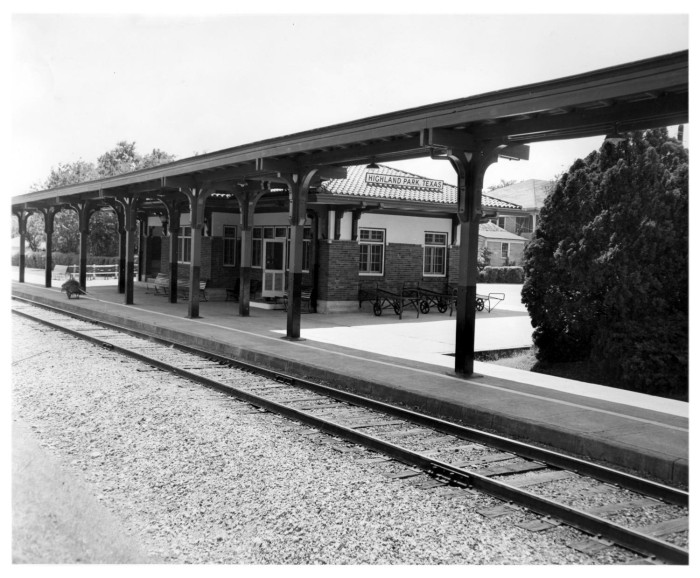
July 1922 · photograph
The Katy railway depot
Highland Park’s Katy depot. A town could be connected by transport without sharing a city government. [18]
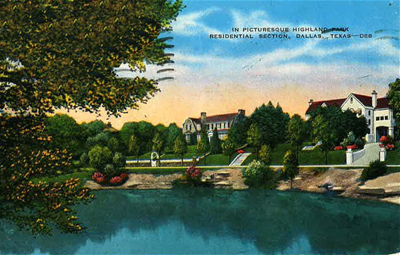
Museum of the American Railroad · UNT LibrariesUndated · postcard
A neighborhood beside the lake
“Picturesque Highland Park” from the town’s archive. The lake, landscaping and houses show the setting promoted to residents. [19]
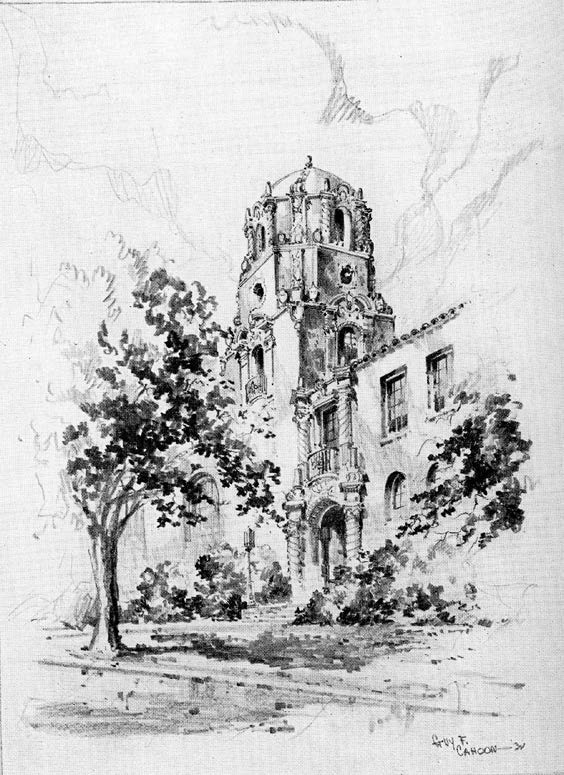
Town of Highland Park · archival postcard1924 · period drawing
Town Hall opens in 1924
Highland Park Town Hall opened in 1924 with administrative offices and a public auditorium. [20]
Claims link to municipal histories, archival descriptions, the Handbook of Texas, a court opinion, Federal Reserve history and a documented historical study. Historical claims reviewed October 13, 2026. Conflicting accounts and the map’s limits are noted below.
The disputed 1913 annexation story
TSHA and the NPS nomination repeat a rejected Highland Park request. Whatley’s later study found no supporting record. This site treats the story as disputed. [5][7][8]
Why you may see different dates
The town dates its incorporation vote to November 29, 1913. The 1925 Guthrie opinion records adoption of municipal statutes in December 1913. Some later histories give 1915; this site uses the town’s 1913 date and notes the disagreement. [3][12][5]
Highland Park’s summary dates Dallas’s campaign to 1919; Whatley documents actions in 1917–18. The timeline follows the earlier documented actions. [3][7]
SMU was founded in 1911 and opened in 1915. The explorer uses the campus opening for the neighborhood’s growth. [6]
What the map shows
The map uses Dallas County Elections’ contemporary municipal boundary representations over OpenStreetMap streets. These GIS alignments are approximate, not a legal survey. They stay fixed across the timeline: changing colors show municipal status and proposed mergers, not a reconstruction of historical boundaries. Preston Hollow is marked by location because its former town limits are not reconstructed. [23][24][4][10]
Oak Cliff and Joppa highlights show recorded annexation tracts. Tenth Street and Wheatley Place highlights show city-published landmark districts. Each label identifies the reference area; its outline does not change to match every timeline year. [37][38]
City and school-district boundaries are different. Municipal annexation should not be read as automatic school-district consolidation. The rules governing each campaign changed over time.